Showing posts with label science capital. Show all posts

Thursday, January 16, 2025

Exploring STEM careers with Oak Academy resources

 We are proud to share a selection of ‘science careers’ lessons created by CIEC as part of the new primary science curriculum recently launched by Oak National Academy. 

The lessons are linked to the National Curriculum for primary science and encourage more children to feel that ‘science is for me.’ 

Children as young as Year 1 (5 and 6-year-olds) will learn about how some people use science every day as part of their job, and how science can be a job for everybody.

A picture of a marine biologist, a zoo keeper and a geologist. The text reads  'Some people choose to have a career in science. This means that they choose to use science as part of their job.There are many different science careers. Can you think of any?
An extract from the Y1 unit on developing new materials

The lessons include opportunities for teachers to uncover and discuss any misconceptions children may have about who might work in a science related career. 

The Oak materials encourage children to discuss preconceptions about STEM careers.

They also encourage young children to consider a range of careers in science- related industries, as they begin to think about future aspirations with information such as... 

“If you like asking questions and finding out about the world around you, then you might like to have a career in science.”

For more information about these lessons, please get in touch with CIEC or visit The Oak National Academy primary science page to access the free primary units.


Wednesday, March 20, 2024

Young People's Book Prize activity sheets


Congratulations to Maggie Alderin Pocock who has recently been crowned the winner of the 2023 Young People’s Book Prize with her book of frequently asked questions about space ‘Am I made of stardust?’.

Part of one of the pupil activity sheets. Most of the text is too small to read but the title is 'Am I made of stardust' and we can see the front cover of the book.

Did you know that CIEC writes resources every year to maximise the learning that is possible from all six of the shortlisted titles? There are separate pupil and teacher activity sheets. Between them, they have sections on relevant careers, on maths links and the profile of a relevant scientist, as well as several engaging science activities which will help teachers to make effective links with the science curriculum and the content of the books.  All of the investigations can be done as standalone activities or carried out as an in-depth sequence to develop pupil’s disciplinary and substantive knowledge. The sheets also contain information about how schools can apply for a Royal Society Partnership Grant of up to £3,000.


Part of one of the activity sheets. most of the text is too small to read but we can see the front cover of 'Live like a hunter gatherer' and the title of the whole sheet is 'Live like a hunter gatherer teacher sheet'

 Whether or not your school has been involved in the judging and whether or not you have access to the books in question, you will find that these free resources can have a positive impact on STEM learning in your class, so why don’t you take a look and let us know what you think?

A stack of books.

We will send a copy of one of the books that has been shortlisted in the past five years to the first three schools to be in touch at ciec@york.ac.uk with information (and ideally pictures) of how they used the CIEC activitysheets in their schools. Additionally, the first 10 schools to get in touch will receive a hard copy of a full set of this year’s activity sheets.


Friday, June 9, 2023

Working with families


An image of a 'mad scientist'.  White, middle aged, lab coat, untidy hair and a crazed look in his eyes.
Stereotypes of 'mad scientists' negatively impact on the science capital of children and their families

In recent years teachers have become increasingly aware of the importance of developing children’s science capital by helping them to understand that science is relevant to their current and future lives and that scientists are ‘people like me’ rather than science being the preserve of a select few that fit prevailing stereotypes.  

An industry at home activity sheet.  Most of the text is too small to read.The title says 'Best Bubbles'.

Children from 3 to 93 will be able to join in with this activity which invites you to work out the best mixture for making bubbles.


At CIEC we believe that we not only need to think about the science capital of the children that we work with but also that of everyone around them. A particularly important influence on children is the family that they live with, so anything that we can do to raise the awareness and aspirations of family members is likely to have a positive impact on children.

An Industry at home activity sheet.  Most of the text is too small to read.  The title is 'Runny Fun'.  A subheading is 'Making Ooblek'

In this exciting activity starch is extracted from potato peel to make ‘ooblek’; whatever your age we guarantee that you will learn something new!


One way to do this is to use our IndusTRY AT HOME activities. They are designed for use with families and are easily resourced at home.  They are interactive and engaging and link aspects of the primary science curriculum with real life contexts.

An Industry at home activity sheet. Most of the text is too small to read.  The heading is 'Washing Powder'

For this activity families are invited to compare different washing products as they learn that product development is an important role for some scientists


There are 18 different IndusTRY AT HOME sheets with a range of activities to suit the whole age range from nursery to Y6.  Teachers have told us that they find them more creative than traditional homework without impacting on their workload. Children have told us that they like collaborating with other family members and find the activities enjoyable. Parents report that they are easier to manage at home than activities that children do not want to do. All of the IndusTRY AT HOME activities are free to download from the CIEC website.


Monday, February 27, 2023

Making Ripples


The front cover of the Industry at Home resource.  The text is displayed in brightly coloured boxes.  All except the titles 'Industry at Home' and 'Making Ripples' is too small to read.

Making Ripples is free to download from the IndusTRY AT HOME page of the CIEC website.


We have recently been adding to our popular IndusTRY AT HOME resources.  Thanks to funding from the Royal Society of Chemistry five new resources will have ideas for activities that can be done with children as young as three, but which can be enjoyed by the whole family including older children.  Indeed, given that they are accessible to such a wide age range you may be surprised by how engaging (and thought provoking) adults find the activities too!

Concentric circles of ripples on water.

Adults as well as children are likely to fascinated by this simple activity.


For example, the activity ‘Making Ripples’ invites families to take advantage of a bright sunny day to explore the way that ripples move on a tray of water as objects are dropped in, or the surface of the water is touched.  As with other IndusTRY AT HOME activities this activity is easily and cheaply resourced with items from around the home.


A screen shot showing part of the resource.  There is white text in a green box which is too small to read apart from the title 'Career and role play opportunities'.  There is also an image of a tug boat.

An extract from the IndusTRY AT HOME resource ‘Making Ripples’


There is also support for raising Science Capital by making links between the science in the activities and real science careers.  For example, after exploring the ways that water moves while making ripples, children learn that people who design and make boats need to know about this to help them to design boats that can move safely through rough seas.

We would love to hear how you get on if you use this resource either at home or in school.


Friday, October 14, 2022

Career Cards

This post is written by one of CIEC's advisory teachers, Jane Winter

 Primary teachers are increasingly aware of the importance of raising children's science capital.  High science capital means that ALL children realise that they too could have a career in STEM if they chose, rather than dismissing the possibility at an early age as "not something done by people like me".

At CIEC we believe that one of the best possible ways to do this is to give primary school children the opportunity to meet real STEM professionals and learn how the science that they do in school links to the science that happens in industry.  However, this isn't always possible and this is where our free to download resource Career Cards come in.  Each set of cards in the pack feature one of four STEM professionals who works with one of our partner companies Johnson Matthey.  One card contains their photograph, another their job title and another a job description.  The complete set for one person also has information about their hobbies and which subjects they enjoyed at primary school.

Career cards spark discussions which help to break down stereotypes about who can be a STEM professional

Upper KS2 children have responded well to using these cards and their teachers have told us that they lead to discussions which help them to realise that anyone can aspire to be a scientist or engineer and that there are a variety of routes into STEM professions.

The cards can be downloaded from our website.  However, if you don't fancy all that cutting out, a class set of 7 packs of cards can be purchased from our online shop at a heavily subsidised cost of £8.15.  If you use them in your own classroom we would love to hear how you get on.

Thank you to Johnson Matthey for funding the creation of these cards and for continuing to subsidise their cost to schools


Tuesday, April 5, 2022

An Eggciting Easter Challenge

Today's blog post is brought to you by Mackayla Miller, one of our advisory teachers based in the North East.


Happy Easter folks! Here at CIEC, it’s no yolk that we’re egg-stremely eggs-cited about inspiring the next generation of scientists and engineers, but we’re also partial to a few terrible egg puns at this time of year.

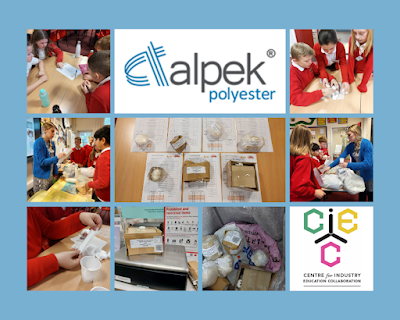
Mackayla has been working with the year 6 children at Levendale Primary School to deliver our egg-cellent Children Challenging Industry (CCI) programme. The ‘Eggs-press Delivery Challenge’ was a tough challenge indeed, but this egg-ceptional group of pupils were willing to whisk it all and refused to be beaten. Working in teams with a budget to spend, the groups hatched their plans, packaged their eggs, shelled out for their materials, and are now eagerly awaiting the arrival of their packages in the post to see to see whose eggs survived the journey.

John Baker and Paul Bickley from Teeside plastics manufacturing company Alpek Polyester UK Ltd, joined the classroom sessions via Zoom to give the children an insight into their jobs and engage them in a remote site visit, including an exciting interactive bottle-drop investigation. But it’s not just the children who benefit from the Children Challenging Industry experience. Here’s what John Baker, HSEQ and Technology Director has to say about getting involved:

“I’ve been involved with CCI for nearly 10 years now and every session, whether face to face or more recently using video conference, is great. The engagement from the children in the classroom is fantastic, with them often asking challenging and thoughtful questions. As well as trying to get across what we do in industry and the rewarding careers from STEM subjects, it is an opportunity to speak directly to teachers about what can be quite limited in the curriculum on science and engineering. In some sessions, explaining what we in industry think is obvious can, when seen through different eyes, put a whole new perspective on things, so it is not just a one-way street. The practical sessions show the children the scale of our operations and seeing their sense of wonder reminds me of my primary school teacher who inspired me into my career (he was a nuclear physicist!). I would recommend anyone in STEM careers getting involved as it is a rewarding session.”

If you would like help to get cracking with your STEM education why don't you contact ciec@york.ac.uk to see if you could become involved in any of our initiatives to link schools with science based industries.  Alternatively, you could try this activity with your class as full teacher notes are available for free from our website.


Full activity notes are available in this free CIEC resource including teacher guidance and safety advice


Tuesday, March 8, 2022

Inspiring the next generation with Tolu

At CIEC we are all about breaking down stereotypes so that ALL children know that there is a place for them in STEM careers if they choose.  We know that there is still important work to do in this area as can be seen in the work done by Inspiring the Future.  If you haven't yet seen their video 'Redraw the Balance' please stop what you are doing and watch it now!
 
 'Redraw the balance' shows that gender stereotypes are embedded by the age of 7.


An important aspect of showing children know that they too could work in STEM are the STEM professionals that we work with who provide children with diverse role models and show them that science and engineering can be a worthwhile career whatever your gender or ethnicity.

Tolu is one of the ambassadors that we work with in the Royston area.  She recently told our advisory teacher Clare Docking

 CIEC does great work, and I am proud to be associated with this organisation! The opportunity to showcase the work that I do as an engineer to an ever so curious and brilliant audience is something I relish and have found to be helpful in refining skills such as public speaking. Being able to give real life context to the children on some of the concepts they learn about in the classroom is something I find enriching. Not only does this help to demystify myths about STEM, but it also raises their awareness of the career prospects, and the role STEM plays in everyday life.

 
Tolu outside number 10 Downing Street

Tolu told Clare that she became interested in maths, physics and chemistry at school and knew from a very young age that she wanted to work in the world of science. Her parents encouraged her to take an interest in the sciences when growing up. However, others were concerned about her becoming a female engineer.  Fortunately, Tolu had the opportunity to visit local industry during work experience where she met a range of people in scientific roles and decided that she would like to become a Chemical Engineer. 

 
She knew that there was a place for women in engineering due to meeting some brilliant female engineers.  Even so, she is often the only female on the team and would really like to see more females in engineering and a greater ethnic diversity, particularly in leadership positions. Tolu enjoys her job very much saying that it is a very varied role and once trained you can work in many different sectors. She feels that she is making an important contribution to society and is doing a valuable job.

Tolu knows that her work as an ambassador for Children Challenging Industry is very important, commenting 


Although these children are still in the early stages of their education, I see it as an opportunity for a company to invest in the continuity of their talent pipeline. Beyond this is the possibility of young people, who as a result of being exposed to the industry feel empowered to pursue a career in STEM.

We would like to thank Tolu for taking the time to inspire the next generation.  If you would like to find out how CIEC could help the children in your school please contact us on ciec@york.ac.uk 


Friday, September 3, 2021

Potatoes to plastic: Cross curricular opportunities

In the third and final post in this series linked to CIEC's latest free resource Potatoes to plastic, Jane Winter explains how it can be used to make meaningful cross curricular links.

The OFSTED report, Maintaining Curiosity, confirmed what experienced teachers already knew, it can be beneficial to both subjects when meaningful cross curricular links are made. However, it is important to do this in a way that values both subjects rather than using one as little more than a vehicle for the other.  In English lessons the teacher should be concentrating on English learning objectives and in science upon science learning objectives. One of my pet hates is when schools, with the very best of intentions, insist that writing has to be as good in other subjects as it is in English. We don't need Vygotsky's zone of proximal development theory to tell us that children are able to do more with support than they are able to do independently. The level of writing in an English lesson is achieved because of skilled teacher support which is not available in a lesson where the teacher's energy is focused on other skills.  Having said that, I have seen great writing about science which has been done in a subsequent English lesson, the children's writing benefiting from an inspirational science experience.
It is important to give children the support that they might need with English during science lessons, but this should not be at the expense of good quality science teaching.

With the value of cross curricular approaches in mind Potatoes to plastic has suggestions for a series of lessons which can be used for English teaching.  They are designed so that the teacher concentrates upon the English learning objectives, and is not trying to juggle too many plates at once.  However, the content is likely to raise children's science capital as it is based upon the biographies of six of the scientists currently working in the award winning Green Chemistry department at the University of York.  Although the focus of the lesson is on reading and writing children learn about the range of exciting jobs that the scientists do, and also find out that scientists are 'normal' people, just like you or I with families and hobbies beyond science.

When reading about real scientists in an English lesson children learn that scientists are normal people with a range of activities and hobbies, from making lego models with their children to enjoying skiing.

The final section of this free publication concentrates upon the range of other solutions to the problem of waste that scientists have developed, from extracting citronella from orange peel to turning cocoa husks into paper bags.  There are a set of downloadable playing cards which can be used for a range of games including 'Memory pairs', 'Old Fossil' and 'Go Recycle' which highlight science solutions to environmental problems.  These could be used as an activity during a science or environmental day.  Alternatively, the link and game instructions could be shared with families so that the cards could be used at home.

The previous two blog posts in this series are still available.  You can find the one about extracting starch from potato peel here, and the one about making bio-plastic from potato peel here.  If you use any of the activities we would love to hear how you get on.  It is feedback from teachers like you that helps us to know what we are doing right and how we can get even better in the future!  
Full instructions for the English activities and the card games as well as how to turn potato peel into bio-plastic are included in this free to download publication

This is what one teacher had to say after using this resource with their class.

Our current topic is all about Endangered Species and a large part of this has been around the dangers of plastics in the oceans and different habitats; so this lesson in particular was a great experience for cross-curricular discussions, the content of which were deep and enriched. In addition to this, the vocabulary resources that accompanied the investigation were a fantastic tool to help deepen the children's understanding and allowed them to speak freely, scientifically and accurately about the processes they were undertaking. Both pupil and teacher thoroughly enjoyed the lesson.


Tuesday, August 31, 2021

Potatoes to plastic: turning potato starch into plastic


The image shows the page from the CIEC website where the resource, Potatoes to plastic, can be downloaded.
This is the second in a series of three posts about CIEC's latest free resource: Potatoes to plastic.

In the previous post I described how potato starch could be easily extracted from potato peel using simple equipment that is readily available in the primary classroom.  Here I will explain how the extracted starch can be used to make bio plastic in a few straightforward steps.  As this quote from a year 5 teacher shows, this activity is not only very engaging, but makes relevant links to the topic of Materials in the English and Northern Irish primary curricula, Earth's Materials in the Scottish curriculum and Myself and non-living things in the Welsh curriculum.

"They have absolutely loved this learning. Thank you for the opportunity to engage Year 5 in such an exciting and relevant project, which has reinforced their previous scientific learning of properties of materials (and has done so in a real-life context they will not forget!) as well as their scientific thinking. This project has led to many wonderful opportunities for cross-curricular links to reading, writing and maths too".

The procedure is even better if you are able to borrow a magnetic hotplate from a local secondary school or University, as can be seen in this demonstration.  However, even without access to this piece of scientific equipment the activity can still be carried out in a saucepan on a cooker hob.

To turn it into plastic, the potato starch need to be mixed with a small quantity of water, glycerin and white vinegar before it is heated.   The mixture is then spread out on a petri dish or saucer and left to harden.  After two or three days these simple ingredients will have set into bio-plastic.  The properties will vary depending upon the exact ratio of the ingredients and how thickly it was spread while drying.  The resource gives guidance as to how children could then investigate the properties of the finished plastic as they explore how it could be used in place of plastics derived from petrochemicals.
Children are invariably delighted with the finished bio-plastic
Experienced teachers will know that even the most engaging activity needs to be planned carefully if the potential learning is to take place. Consequently, the resource gives additional  guidance  including vocabulary prompt cards which support children to use the correct terminology as they describe what has happened.  This also supports them to link the experience to past science learning.

Children using the list of vocabulary to support them to talk about the activity in a more scientific way.

In the final post in this series I will explain how this resource can be used in English lessons and to develop children's understanding of how science is working to find solutions to other environmental problems.  
Full instructions including health and safety advice can be found in the free resource available from our website.


This post was written by Jane Winter who is one of our advisory teachers who works in Lincolnshire and Yorkshire.


Tuesday, August 10, 2021

Potatoes to plastic: Extracting starch from potato peel


This is the first in a series of three posts which have been written by one of our advisory teachers, Jane Winter.  They are based upon our latest free resource: Potatoes to Plastic

Frequently, scientists are the bearer of bad news.  Every day we read about mounting evidence of climate change, loss of bio-diversity and the prevalence of micro-plastics in the ocean. However, did you know that as well as identifying environmental problems scientists are able to develop solutions to some of them?  The world leading Centre of Excellence in Green Chemistry where scientists work on finding new ways to overcome ecological issues is based at the University of York.

CIEC has been working with some of the scientists from Green Chemistry to develop our latest resource, Potatoes to Plastic which looks at how scientists have been able to develop useful products from a range of waste materials which might otherwise go to landfill.  As well as looking at several examples of this scientific approach to environmental problems, this free publication looks at one example, making bio-plastic from potato peel, in more depth.  Teachers are supported to carry out some straight forward activities with their class which link closely to the materials strand of the KS2 science program of study.  They extract starch from a waste product, potato peel, and then turn that starch into plastic.

Extracting starch from potato peel does not require a lot of expensive equipment. 

I have found the raw material for this activity easy to source.  Although not all chip shops peel their own potatoes, once you find one that does they will almost certainly be prepared to let you have the peel for free. Alternatively, you may find that your school dinner provider is able to give you some.  Another possibility is to use wrinkly old potatoes that have started to sprout and which might otherwise have been thrown away.

Blending the potato peel with water


First of all you will need to blend the peel and a generous quantity of water in a food processor or blender. Give each pair of children a small jug full of the mixture each.  They will need to filter the peel and water mixture by squeezing it through the foot of an old pair of tights or pop socks.  This will produce a white liquid which is a mixture of potato starch and water.  The rest of the solids are left behind and can be disposed of on a compost heap.

Pouring the blended potato peel and water into a pop sock.

After a few minutes the potato starch will start to settle at the bottom of the container.  Once this has happened the water can be poured carefully off to leave behind the wet starch.  At this point children will be amazed to find that they are left with 'oobleck' which is usually made by mixing cornstarch and water.  That is because the starch found in potatoes is exactly the same as starch found in corn.  Once children have finished playing with the oobleck it will need to be left in a shallow container such as a saucer or petri dish to dry.  After a few days all of the water will have evaporated and you will be left with dried potato starch.  

In the next post I will explain how you can turn the potato starch into plastic.  However, if you cannot wait why not check out the full instructions for both activities on the website.  This includes teachers' notes, children's activity sheets and health and safety advice.  This is what one teacher who recently carried out the activity with their class had to say about it.

'Absolutely fantastic! The children have never felt so alive, enthused and engaged in a science lesson that I have taught. They absolutely loved the practical element of blending the potatoes, filtering the starch and using interesting 'ingredients' to create the plastic. Their scientific skills were so clear and they were all extremely careful in measuring their resources and ensuring the investigation plan was carefully followed. The time taken for the excess water to evaporate and leave the powdered starch behind kept them even more engaged as they spoke about nothing for days until it was ready to use'.

Thursday, May 20, 2021

Out of this world science: linking your teaching to space exploration


This post is brought to you by Jane Winter who is one of our advisory teachers based in York and Lincolnshire

This week sees the launch of CIEC's latest IndusTRY AT HOME activity.  As teachers who have worked with us before will know, InusTRY AT HOME is a suite of activities that we have adapted to make user friendly for families.  Each one is based on one of our existing tried and tested science lessons.  They require minimal equipment that can be readily found around the home.  The instructions are written specifically with families, rather than trained teachers in mind.  

The whole set of activities has been very well received by teachers, families and children alike and we are told that they are used in a number of ways.  For example, individual activities being set as homework or the link to the whole page of activities being added to the school website.  Families have also stumbled across IndusTRY AT HOME on the internet and have accessed them independently of school.

Teachers have also told us that they use the activities in their day to day teaching, often sending the activity home after they have used it in the classroom.  Another way that these can be used in school is to do a related, but completely different, practical lesson.  Since all of the IndusTRY AT HOME activities are taken from one of our resources this is easy to do.  This latest activity, for example, is from our free to download publication Is Anyone Out There? which contains eight other activities as well as this one about investigating craters.

All of our free to download resources, including this one, can be found on our Primary Website


One of the activities from this publication that I have enjoyed doing with children is to give them different soil samples to test in the same way that scientists will test any samples that are brought back from Mars (recipes are provided in the resource for the preparation of the different samples).  This is an unusual and exciting way to approach the study of rocks and soils.  As well as investigating the properties of the different soil samples children test them for signs of life.  As you can imagine, there is great excitement when signs of life ARE found in one of the samples. If you would like to find out how to do this you will need to download the resource.

Another great activity from this publication is one which explores volcanos (while helping children to consolidate their understanding about changing materials).  I must tell you now that there is no truth to the rumour that the involvement of chocolate has any bearing on my enjoyment of this particular activity!

A teacher exploring volcanos at one of our CPD sessions.

I hope that I have tempted you to check out this lovely publications.  As ever, if you use it with your class we would LOVE to hear how you get on.  Don't forget, if you would like to be kept up to date with what is happening at CIEC you can sign up for our newsletter by emailing ciec@york.ac.uk.  We will never send more than one email a month and you can unsubscribe at any time.


Wednesday, January 20, 2021

Fun with Foam: What Makes Good Foam?

 Children love to play with foam, whether when mixing bubble bath and water in the bath to create the biggest foam possible or using shaving foam for sensory play when younger, as in this picture.

In this fun investigation the children make foam and then devise a way of measuring it. It is easy to set up as it involves using everyday household materials for the foam production - a simple mixture of soap, oil and water for the test ‘sample’ and commercially produced bubble bath for comparison.  Children enjoy predicting which product they think will create the biggest and longest lasting foam and then testing to see if they are right. This activity will prompt them to consider the importance of carrying out a fair test.

Full details of activity can be found in our free resource and incudes teachers’ notes, children’s activity sheets and national curriculum links


Three, two, one – investigate!

  • Children love a challenge, so start the fair test investigation by telling them that scientists at Sumptuous Skincare Ltd have sent a sample of their new bubble bath. They would like the children to use a method of foam production to test how the sample they have produced compares with one or more known brands of creamy bath foam.
  • First, explore the idea of ‘foam’ with the children. Where have they seen foam before? Give them some examples, such as shaving foam, bath foam, foam on top of milky coffee or foam on the sea on a windy day.  What qualities does foam have and how is it different from lather or bubbles? How do the children think that foam is produced?
  • Have a selection of baths foams to hand, including the pre-made ‘test sample.’ Ask them how they are going to ensure that they test all the different foams so that all conditions are kept the same. How will they make the foam? (Ways to produce foam include blowing through a straw, stirring, whisking, beating or shaking).
  • Once the children have decided on what they need to keep the same for a fair test, they need to consider how they might measure results. How will they measure the success of the foam created? The activity lends itself to a variety of measuring and recording methods, so it is ideal if you are working with different age groups. 
  • The children will love to report back findings to the class and ultimately to Sumptuous Skincare in a variety of ways such as videos, reports, letters or photos with captions.

 Top Tips

Here are some tips to make your investigation a success:

  • This activity is perfectly suited for COVID secure working as it can easily be carried out individually, in pairs or small bubbles as equipment is inexpensive and easily available.
  • Encourage the children to spot mistakes in their own processes and hold mini plenaries to discuss these e.g. did they use the same number of whisks to create the foam?
  • One easy way to conduct this investigation is to mark graduations of 100 ml up the side of a two-litre pop bottle. The bath foam and 300 ml of water are added, the lid tightened, and the bottle shaken vigorously. Ten shakes later, how much foam is produced?
  • For accurate measurement, use a pipette or syringe to add the soap to water.

This month’s blog is brought to you by Clare Docking, one of our advisory teachers who works with industry and schools in the East of England.


Friday, November 13, 2020

Filter fun

This month’s blog is brought to you by Clare Docking, one of our advisory teachers who works with industry and schools in the East of England.

Children love to play with mixtures combining solids and liquids to make something different.  In this activity we take this one step further and use filters to reverse this process and separate out the solid again. This investigation is easy to set up as it involves using everyday household materials for the filtering and uses a simple mixture of flour and water for the solution.  Children will enjoy predicting which filter they think will do the best job of separating out the solid from the liquid and then testing to see if they are right. This activity will prompt them to consider the properties of materials and why some make good filters, and some don’t.

Three, two, one – investigate!

    • Children love a challenge, so start the investigation by telling the children that a local bio tech company needs their help to find out which material makes the best filter. You could explain that medicines are grown in solutions and then the ‘solids’ grown need to be separated again afterwards. Brainstorm ideas on everyday filters e.g. colanders, tea strainers,plug hole filters.
    • Give the children a choice of filters e.g. kitchen roll, tissue, cotton fabric, J cloth, and a commercially produced filter paper such those for coffee machines. Ask them how they are going to ensure that they test all the different filters so that all conditions are kept the same except for changing the filter used?
    • Encourage the children to draw on their own experiences when thinking about the task. Do they think any of the filters might go soggy? Are some of the materials more tightly woven and will this be good or bad for filtering? How much do they pour at once and how do they ensure no spillage? Does it matter if the solution is lumpy? This is a good opportunity to bring in previous learning about how liquids and solids behave and to examine the difference between a ‘solution’ and a ‘suspension’. 
    • Once the children have decided on what they need to keep the same for a fair test, they need to consider how they can measure results. How will they measure the success of the filter?  This activity lends itself to a variety of measuring and recording methods.  They could, for example, measure the clarity of the liquid produced, or the amount of flour in the filter. Ask the children to time how long the filtering process takes with each material – how might the time taken by each filter be relevant to the bio-tech company when they decide which filter to use?
    • The children will love to report back findings to the class and ultimately the bio-tech company in a variety of ways e.g. videos, reports, letters or photos with captions.


This activity is taken from this  free resource: Cough Syrup
Full details of activity can be found in our free resource and incudes teachers’ notes,

children’s activity sheets and national curriculum links.


Top Tips

Here are some tips to make your investigation a success:  

  • This activity is perfectly suited for COVID secure working as it can easily be carried individually, in pairs or small bubbles as equipment is inexpensive and easily available.
  • Encourage the children to spot mistakes in their own processes and hold mini plenaries to discuss these. For example, is any liquid running down the side of the filter when they pour it?
  • Allow plenty of time for the investigation as some of the filters work more slowly than others. While the children are watching and waiting for the filtering to take place, encourage them to record ideas about their testing process on post-its or devise a table to record results.
  • If you don’t have any funnels or containers, simply cut the top off a plastic bottle (e.g. bottled water) and in an instant you have the container and funnel (NB. Be aware of sharp edges – cover with tape if necessary).

If you would like to share this activity with children's families, why don't you put a link to this related IndusTRY at home activity on your school website?